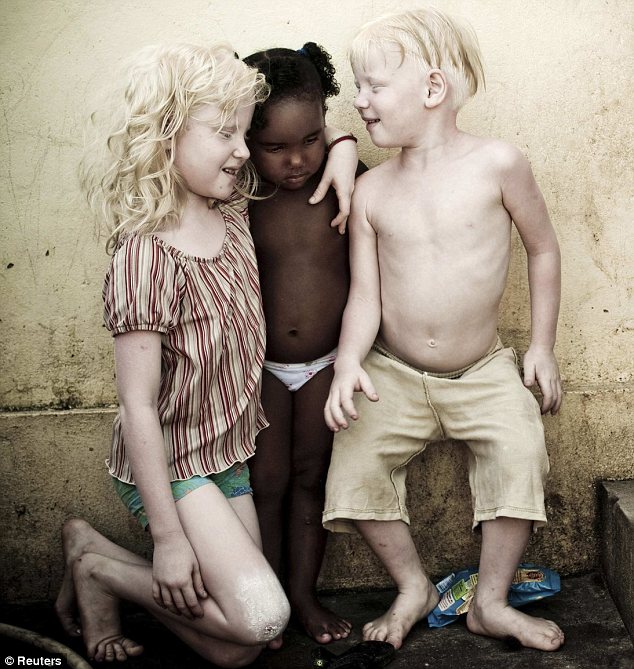
What is albinism?
People with albinism have little or no pigment in their eyes, skin, or hair. These are inherited conditions where altered genes do not produce the usual amounts of melanin.
Who is affected by albinism?
People of all races can be affected. Sometimes, people do not know when they have albinism. There are different types of albinism and the amount of pigment in the eyes varies. There is a myth that people with albinism have red eyes, but many have violet, blue, hazel, or brown eyes. However, all forms of albinism are associated with vision problems. People with the less pigmented type of albinism, often have vision in the range of 20/200.
Since people with albinism have fair complexions, skin, or hair, they are more susceptible to the sun's rays. They must take precautions when going outside, such as wearing sunscreen, hats, and sun-protective clothing.
People with albinism have little or no pigment in their eyes, skin, or hair. These are inherited conditions where altered genes do not produce the usual amounts of melanin.
Who is affected by albinism?
People of all races can be affected. Sometimes, people do not know when they have albinism. There are different types of albinism and the amount of pigment in the eyes varies. There is a myth that people with albinism have red eyes, but many have violet, blue, hazel, or brown eyes. However, all forms of albinism are associated with vision problems. People with the less pigmented type of albinism, often have vision in the range of 20/200.
Since people with albinism have fair complexions, skin, or hair, they are more susceptible to the sun's rays. They must take precautions when going outside, such as wearing sunscreen, hats, and sun-protective clothing.
Albinism
Albinism is a defect of melanin production that results in little or no colour (pigment) in the skin, hair, and eyes.






Types of Albinism
1) Oculocutaneous albinism (OCA)
Involves the eyes, hair, and skin.
2) Ocular albinism (OA)
Less common, involves primarily the eyes. Skin and hair may appear lighter that that of other family members.
Each of the above types of albinism can be classified into subtypes. For more information on the four forms, visit
the NOAH website.
Complete Albinism (Less pigmented)
- hair and skin are cream-coloured
- vision often in the range of 20/200
Incomplete Albinism (Slight pigmentation)
- more yellow or red-tinged hair
- better vision than people with less complete albinism
1) Oculocutaneous albinism (OCA)
Involves the eyes, hair, and skin.
2) Ocular albinism (OA)
Less common, involves primarily the eyes. Skin and hair may appear lighter that that of other family members.
Each of the above types of albinism can be classified into subtypes. For more information on the four forms, visit
the NOAH website.
Complete Albinism (Less pigmented)
- hair and skin are cream-coloured
- vision often in the range of 20/200
Incomplete Albinism (Slight pigmentation)
- more yellow or red-tinged hair
- better vision than people with less complete albinism
Shirley Ngai
Psychology 3190G
Dr. Timney
Psychology 3190G
Dr. Timney