Low Vision Aids
Low vision aids are available to help people with albinism see. There are advantages and disadvantages to the different types of aids but it is important to understand how each should be used. Each aid is used for different tasks so it is likely that a person will have many different aids.
Below are a list of some of the more popular low vision aids used to improve one's vision.
---------------
Glasses
- Fixes low vision
- It is important for young children to wear glasses to correct refractive error.
- If a child who needs glasses doesn't wear them, they may not try new things and may affect their development.
----------------
Near vision aids
- Dome magnifiers (one of the easiest aids to use)
- Hand-held and stand magnifiers (enlarges close-up images)
- Microscopes (see smaller details than magnifiers produce)
- Helps with reading, looking at pictures, diagrams, and maps.
Low vision aids are available to help people with albinism see. There are advantages and disadvantages to the different types of aids but it is important to understand how each should be used. Each aid is used for different tasks so it is likely that a person will have many different aids.
Below are a list of some of the more popular low vision aids used to improve one's vision.
---------------
Glasses
- Fixes low vision
- It is important for young children to wear glasses to correct refractive error.
- If a child who needs glasses doesn't wear them, they may not try new things and may affect their development.
----------------
Near vision aids
- Dome magnifiers (one of the easiest aids to use)
- Hand-held and stand magnifiers (enlarges close-up images)
- Microscopes (see smaller details than magnifiers produce)
- Helps with reading, looking at pictures, diagrams, and maps.
How Vision is Affected by Albinism & Low Vision Aids




Vision Problems with Albinism
People with albinism do not develop the pigment needed for the eyes which results in abnormal development of the retina. This also affects nerve pathways from the eyes to the brain. Because of this, visual acuity is decreased in which vision can not be corrected to 20/20.
There are aids to help such as corrective lenses (glasses/contact lenses) and low vision aids (magnifiers and telescopes). Most people with albinism use their vision to read, and some have good enough vision to drive.
People with albinism do not develop the pigment needed for the eyes which results in abnormal development of the retina. This also affects nerve pathways from the eyes to the brain. Because of this, visual acuity is decreased in which vision can not be corrected to 20/20.
There are aids to help such as corrective lenses (glasses/contact lenses) and low vision aids (magnifiers and telescopes). Most people with albinism use their vision to read, and some have good enough vision to drive.

Distance vision aids
Telescopes
- Can help with seeing a chalkboard in a classroom, seeing a menu board at a fast-food restaurant, or seeing the stage at a concert.
- Telescopes come in various ranges of magnification power. The greater the magnification power of the telescope, the more fine detail the person can see.
- Disadvantage: When the magnifying power increases, the view of the field becomes smaller.
Hand-held Telescope (Monocular)
- Variety of sizes, magnification powers and prices.
- Works best to quickly view a distant object.
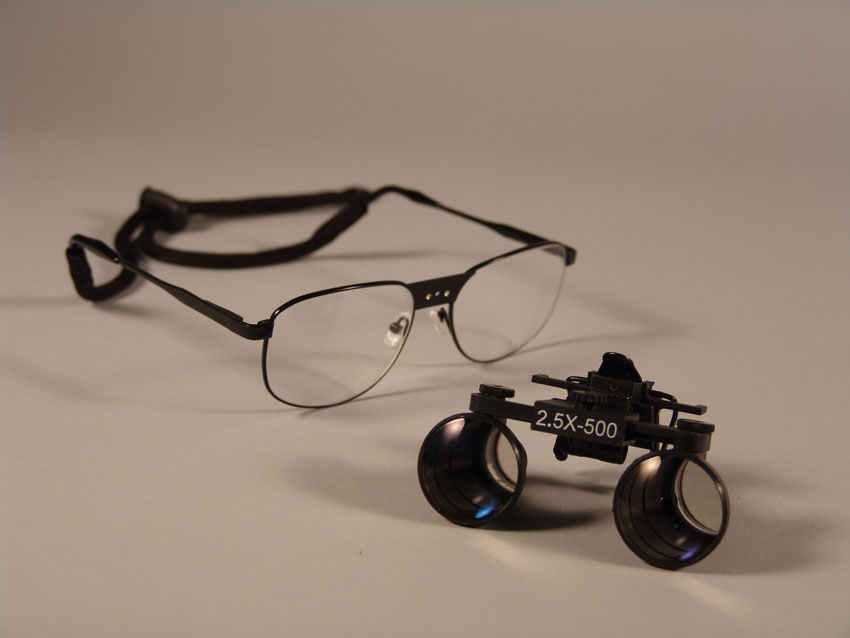
Clip-on Telescopes
- Slip the telescope over glasses for hands-free use.
- Works well for long time exposure to viewing something in a distance (e.g. Watching TV).
---------------------------
Telescopes
- Can help with seeing a chalkboard in a classroom, seeing a menu board at a fast-food restaurant, or seeing the stage at a concert.
- Telescopes come in various ranges of magnification power. The greater the magnification power of the telescope, the more fine detail the person can see.
- Disadvantage: When the magnifying power increases, the view of the field becomes smaller.
Hand-held Telescope (Monocular)
- Variety of sizes, magnification powers and prices.
- Works best to quickly view a distant object.
Clip-on Telescopes
- Slip the telescope over glasses for hands-free use.
- Works well for long time exposure to viewing something in a distance (e.g. Watching TV).
---------------------------
Electronic aids
Closed Circuit Television (CCTV)
- Helps people who need better magnification than reading glasses, magnifiers, and microscopes
- Allows the user to adjust the size, brightness, and contrast of the magnified image.
- Disadvantage: More expensive and less portable than other near vision aids.
- The MagniCam® is smaller, more versatile, more portable, and less expensive then previous CCTV systems.
Where Can I Find Low Vision Aids?
An optometrist or ophthalmologist who specializes in low vision can recommend specific aids to people with albinism. Low vision clinics have a variety of aids on site to see and try. It's important to try out as many aids as possible before choosing. Sometimes, the newest or most expensive aid is not the best choice.
An optometrist or ophthalmologist who specializes in low vision can recommend specific aids to people with albinism. Low vision clinics have a variety of aids on site to see and try. It's important to try out as many aids as possible before choosing. Sometimes, the newest or most expensive aid is not the best choice.
A child using a dome magnifier.
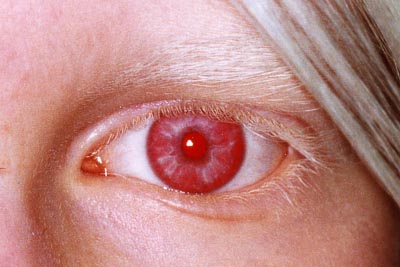
Some people with albinism have red eyes.
Clip-on telescopes
Shirley Ngai
Psychology 3190G
Dr. Timney
Psychology 3190G
Dr. Timney